
100% जॉब प्लेसमेंट और भरपूर प्रैक्टिकल | देश–विदेश में जॉब का अवसर
ISO 9001:2015 QMS Certified Institute

United Professional Techsafe Training Institute (UPTTI), Lucknow invites applications for its comprehensive NDT (Non-Destructive Testing) Level Course Training. This specialized program is designed for students, diploma holders, engineers, and working professionals who aspire to build a rewarding career in quality assurance, inspection, and testing across industries such as Oil & Gas, Aerospace, Power Plants, Railways, Petrochemicals, and Construction.
The training covers Level I, II, and III certification modules, ensuring candidates gain both theoretical knowledge and hands-on practical experience with the latest NDT techniques including Liquid Penetrant Testing (LPT), Magnetic Particle Testing (MPT), Radiographic Testing (RT), Ultrasonic Testing (UT), and Visual Testing (VT).
With ISO 9001:2015 QMS Certified standards, UPTTI provides world-class training facilities, modern inspection equipment, and 100% placement support in India and abroad. Whether you are a fresher or an experienced professional, this course empowers you with the skills and global certification required to become an industry-ready NDT Inspector.
Get fully certified through professional NDT training and certification at Level 1, Level 2, and Level 3 in the following cities: Agra, Aligarh, Bareilly, Firozabad, Ghaziabad, Gorakhpur, Greater Noida, Jhansi, Kanpur, Lucknow, Meerut, Moradabad, Noida, Prayagraj, Saharanpur, and Varanasi. From NDT Level 1 training to NDT Level 3 training, NDT Level II certification, our training courses mainly focus on providing hands-on practical skills and industry exposure to successfully get you certified as a NDT Level 2 inspector or Level III professional. Call us today and kick off your NDT career Contact us today to reserve your spot!
Detailed explanation of the core Non-Destructive Testing techniques you will master
Liquid Penetrant Testing (LPT), also known as Dye Penetrant Testing (DPT) or Penetrant Testing (PT), is one of the most widely used surface NDT methods. It is highly effective for detecting open-to-surface discontinuities such as cracks, porosity, seams, laps, and other surface-breaking defects in both metallic and non-metallic materials.
In this method, a liquid penetrant (usually a visible dye or fluorescent dye) is applied to the cleaned surface of the component. Capillary action draws the penetrant into any surface-breaking flaws. After a suitable dwell time, excess penetrant is carefully removed from the surface, and a developer is applied. The developer draws the trapped penetrant out of the defects, making them clearly visible under white light (for visible dye) or ultraviolet light (for fluorescent penetrant).
At UPTTI, students receive comprehensive theoretical knowledge and extensive hands-on practical training in all stages of LPT – surface preparation, penetrant application, dwell time control, excess removal techniques, developer application, inspection, and interpretation of indications. This method is widely applied in industries such as aerospace, automotive, oil & gas, power plants, and fabrication shops.
Magnetic Particle Testing (MPT), also referred to as Magnetic Particle Inspection (MPI) or MT, is a highly sensitive surface and near-surface NDT method used exclusively on ferromagnetic materials such as iron, nickel, cobalt, and most of their alloys.
The technique works by magnetizing the test object. When a magnetic field is established and a discontinuity interrupts the magnetic flux lines, leakage fields are formed at the surface of the defect. Fine ferromagnetic particles (dry powder or wet suspension) are then applied. These particles are attracted to the leakage fields and form visible indications that clearly outline the size, shape, and location of the defect.
UPTTI’s MPT training covers both longitudinal and circular magnetization techniques using permanent magnets, electromagnetic yokes, prod methods, and coil magnetization. Students practice with dry powder, wet fluorescent, and wet visible particle methods, learning proper magnetization techniques, field strength measurement, particle application, interpretation of indications, and demagnetization procedures. MPT is extensively used in the inspection of welds, castings, forgings, and critical components in railways, power generation, oil & gas, and heavy engineering industries.
Radiographic Testing (RT) is a volumetric NDT method that uses penetrating radiation (X-rays or gamma rays) to examine the internal structure of materials and components. It is one of the most reliable techniques for detecting internal discontinuities such as porosity, inclusions, cracks, lack of fusion, incomplete penetration, and other volumetric defects that cannot be seen by surface methods.
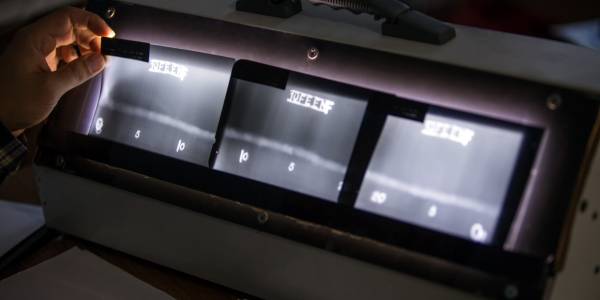
In radiographic testing, a radiation source is placed on one side of the object and a radiation-sensitive film or digital detector is placed on the opposite side. The radiation passes through the material; denser areas or defects of different thickness/attenuation create varying degrees of exposure on the film or detector, producing a permanent image (radiograph) that reveals the internal condition of the component.
At UPTTI, the RT training module includes radiation safety, types of radiation sources (X-ray machines and gamma-ray sources such as Iridium-192 and Cobalt-60), film processing techniques, radiographic techniques (single-wall, double-wall, panoramic), image quality indicators (IQIs), film interpretation, and evaluation of weld quality according to codes and standards. Special emphasis is given to radiation protection, safety procedures, and proper handling of radioactive sources. Students also gain exposure to film interpretation (RTFI) skills that are highly valued in the industry.
Ultrasonic Testing (UT) is a powerful volumetric NDT method that uses high-frequency sound waves (typically in the range of 0.5 to 25 MHz) to detect internal flaws, measure thickness, and evaluate material properties. It is highly sensitive, provides accurate depth information of defects, and can be applied to a wide range of materials including metals, plastics, and composites.
In the pulse-echo technique (most commonly used), an ultrasonic transducer generates short pulses of sound waves that travel through the material. When these waves encounter a discontinuity or the back wall of the component, they are reflected back to the transducer. The time of flight and amplitude of the reflected signals are displayed on a screen (A-scan), allowing the operator to determine the location, size, and nature of the defect.
UPTTI provides thorough training in both contact and immersion ultrasonic testing. Students learn the principles of wave propagation, transducer selection, calibration of instruments using calibration blocks, scanning techniques (straight beam, angle beam, and immersion), interpretation of A-scan, B-scan, and C-scan presentations, and sizing of defects. Practical sessions cover weld inspection, thickness gauging, lamination detection, and corrosion mapping – skills that are essential for careers in oil & gas, power plants, aerospace, and structural inspection.
Visual Testing (VT), also known as Visual Inspection, is the most fundamental and widely applied NDT method. It involves the direct or remote visual examination of components, welds, and structures to detect surface discontinuities, dimensional variations, surface conditions, and overall workmanship.
Although it may appear simple, professional visual testing requires trained eyes, proper lighting, magnification tools, measuring instruments, and a thorough understanding of acceptance criteria as per applicable codes and standards. VT can be performed with the naked eye (direct visual examination) or with the aid of mirrors, borescopes, fiberscopes, cameras, and other optical aids (remote visual examination).
In the UPTTI curriculum, Visual Testing is taught as a critical first step in any inspection process. Students learn surface preparation requirements, lighting standards, use of measuring tools (weld gauges, micrometers, calipers), identification of common weld discontinuities (undercut, overlap, porosity, cracks, incomplete penetration, etc.), and evaluation against codes such as ASME, AWS, and API. Mastering VT is essential because many defects can be detected and corrected early through careful visual examination, saving significant time and cost in subsequent NDT methods.
Who can apply for the NDT Level Course Training?
Students who want to start a technical career path.
Mechanical, Civil, Electrical graduates preferred.
QA/QC engineers or inspectors seeking upskilling.
Students who aim to build careers in Oil & Gas, Power & Construction.
Why UPTTI’s NDT training is the right step for your career growth
Dedicated placement support with career opportunities in India & abroad.
Hands-on training with the latest industry-standard testing equipment.
ISO-certified course to boost your international career prospects.
Learn directly from certified NDT professionals with global experience.
Enroll today for our upcoming NDT Level Course Training.
Hurry up — limited seats available for the new batch!
To achieve your desired results, our development effort extends beyond the training room. We are committed to create a strong and continuous improvement in human capital performance with organizations.
To achieve your desired results, our development effort extends beyond the training room. We are committed to create a strong and continuous improvement in human capital performance with organizations.
Regional expansion in the field of Technical training , NDT
& Manpower consultancy to develop a strong base of key
customers.
Increase the assets and investments of the company to
support the development of services.
To build good reputation in the field of technical training
& Manpower consultancy management and become a key
player in the industry.


If you want to learn safety training then this is the right place for you. I learn better ...
Undergone welding inspection training at welding technology in Uptti, It has got really well-experienced staff in there. Liked ...
The training was excellent with Good interaction, Knowledge sharing is good, the course was practical and informative.
Perfect place to learn NDT & QA/QC Inspection. The institution has a very calm and encouraging study environment ...
Training was excellent with good interaction. Knowledge shearing is good. All facility is excellent.
I greatly appreciate to UPTTI team, they are giving 100% practical training for all courses.
One of the right place to have knowledge of technical and academic studies?Having good experienced and professional faculties to guide for the goals

